Wednesday, August 22, 2007

Ho'oponopono


Ho'oponopono means to make right. Essentially, it means to make it right with the ancestors, or to make right with the people with whom you have relationships. We believe that the original purpose of Ho'oponopono was to correct the wrongs that had occurred in someone's life including Hala (to miss the thing aimed for, or to err, to disobey) and Hewa (to go overboard or to do something to excess) which were illusions, and even 'Ino (to do harm, implying to do harm to someone with hate in mind), even if accidental.

This description is by no means a complete training in how to do Ho'oponopono. While appropriate to do for yourself, for yours and others safety, it should not be done with someone else without training.

For example, let's say your five-year-old grandson punched another five-year-old intentionally with hate in mind. If asked, then the one who was punched would forgive the other immediately, because it is inappropriate for anyone to carry guilt any longer than they had to, if it were not necessary.

We call this the Hawaiian Code of Forgiveness, and it's an important thought, because when we forgive others, who are we forgiving? Ourselves, of course.

If you are familiar with Neuro Linguistic Programming (NLP), there is a saying, "People are only doing the best they can with the resources they have available." If you've heard that before, it has to do with forgiveness. Think about it. As you do consider that you are included in "people."

In the Eastern traditions, too, there is a real tradition of being aligned with and cleaning up relations with the ancestors. In Japan, China, as well as the Hawaiian tradition, it is thought to be important to align and clean up any past problems that you've had in relationships, especially with relatives.


At the same time, perhaps there are family patterns you do not want. Certainly you have heard the saying, "We just don't do that in our family," or "That's the way it is in our family." What happens then, is that certain generational themes get passed along in families, like sadness or any number of different traits. Ho'oponopono will allow you to clean this up.

THEORY: We carry inside us as parts of the Unconscious Mind, all the significant people in our lives. (These parts of us often look very much like Carl Jung's archetypes.) Ho'oponopono makes it "all right" with them. The process of Ho'oponopono is to align with and clean up our genealogy as well as to clean up our relationships with other people in our lives.

The Process of Ho'oponopono:

  1. Bring to mind anyone with whom you do not feel total alignment or support, etc.
  2. In your mind's eye, construct a small stage below you
  3. Imagine an infinite source of love and healing flowing from a source above the top of your head (from your Higher Self), and open up the top of your head, and let the source of love and healing flow down inside your body, fill up the body, and overflow out your heart to heal up the person on the stage. Be sure it is all right for you to heal the person and that they accept the healing.
  4. When the healing is complete, have a discussion with the person and forgive them, and have them forgive you.
  5. Next, let go of the person, and see them floating away. As they do, cut the aka cord that connects the two of you (if appropriate). If you are healing in a current primary relationship, then assimilate the person inside you.
  6. Do this with every person in your life with whom you are incomplete, or not aligned.
    The final test is, can you see the person or think of them without feeling any negative emotions. If you do feel negative emotions when you do, then do the process again.

Sunday, July 29, 2007

Kundalini in Hermetic Philosophy


Kundalini in Hermetic Philosophy

Serpent Power, Caduceus and Yogic Tradition

© W. Hommel

"Kundalini" was a popular concept with Hermetic philosophers. It is favored in the West today for its mediation qualities.

What is Kundalini?

"Kundalini" is a Sanskrit word meaning "coiled up like a snake." It refers to the coiled spiritual energy humans store within their bodies. This energy can be released through various techniques of spiritual enlightenment. The concept of kundalini became popular with Western alchemists because it was associated with the caduceus (the staff of the Greek god Hermes). Here, snakes were entwined around Hermes’ staff. Some scholars speculate the caduceus could have been an early symbolic motif used to convey the idea of kundalini.

What Happens to Someone in Kundalini State?

When one transpires into a kundalini state, they are said to experience visions, out of body experiences, loss of feeling or intensity of feeling. One might experience this state for a mere second or two, but it could last much longer. For each individual, this will vary.

Images of Kundalini in Alchemical Texts

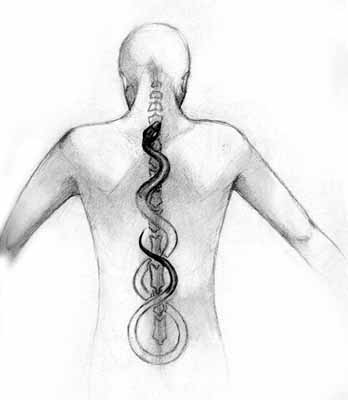
Images of kundalini usually portray two snakes, similar to the caduceus staff, wrapped around a person's spine and extending upwards.

How to Reach Kundalini

Some believe kundalini can be reached through a number of yoga-like exercises. These include:

  • breathing techniques
  • visualizing your inner chakra moving throughout your body, down through your spine
  • singing or repeating a certain phrase
  • letting go of anxiety or stress (visualizing yourself overcoming them)
  • feeling kundalini energy travel up through the base of your spine

Proof of Kundalini Experiences

Some psychologists believe it is possible for people to reach some kind of "kundalini state." In 1932, Carl Jung held a presentation himself on the power of Kundalini. Sometimes these states of mind are compared to the physical Nirvana state: sopadhisesa (Nirvana on earth). To reach sopadhisesa, one must also practice meditation techniques and go through extensive training. It is believed Buddhists monks can have out of body experiences through this procedure. Other psychologists argue however, that these altared states of reality can harm a person, and should not be practiced. They believe nerve endings can be damaged in the process.

It is important to note that there is no solid proof of kundalini. Kundalini remains a philosophical concept, although mediation practices in Asia have long been practiced. The concept of "chakras" is gaining popularity in the West today, while yoga practices continue to penetrate the mainstream.

Is There a God also by the Name of Kundalini?

Yes. The word kundalini is sometimes interchangeable with a god (when used so, the "k" is capitalized). The god Kundalini is associated with serpents.

Saturday, July 7, 2007

Haft Paykar

Nizami's "Seven Beauties"
Ancient Wisdom for the New Millennium
by Laurel Victoria Gray

Left: Laurel Victoria Gray

Written in 1197, "Seven Beauties" ("Haft Paykar" in the original Persian, and "Yeddi Gozal" in Azeri) tells of the adventures of Bahram Gur, a prince destined to become the ruler of the world. Nizami, the creator of this epic poem, was born in Ganja, a town in Azerbaijan where he spent his entire life. Today
Nizami is celebrated as a national poet throughout Azerbaijan, as well as in Iran since the poem was written in Persian, the court language of the day throughout the region.

In Seven Beauties, the young warrior Bahram Gur enters a mysterious, locked room to discover the portraits of seven beautiful princesses, each from a different land. When he wins a kingdom and achieves great wealth and power, he remembers the maidens and summons each of them, commissioning the architect Shideh to build seven domed structures - one for each bride.

Shideh designs each of the domed structures, or "gonbasian", to be astrologically linked with a specific planet, color and day of the week. After two years, the buildings were ready, and the king sent for the princesses.

Bahram Gur then visits each bride on her day of the week, dressing with care in her signature colors. Each maiden tells the king a tale, an engaging story containing a moral lesson. Thus Bahram Gur progresses from Saturday to Friday, from black to white, from darkness to illumination. When he finally emerges from the palace of the Persian Princess of the White Dome, it is the first day of Spring - Novruz - the beginning of the New Year.

Left: The Indian Princess of the Black Dome, portrayed by Monica Ullagadi, uses Kathak dance story to teach the moral lesson of Patience.

My first encounter with Nizami's hero Bahram Gur came while researching Persian miniature paintings at the Metropolitan Museum of Art. The theme of the legendary king visiting each of his seven princesses was a favorite subject for Eastern artists, and the paintings were ornamented with such exquisite detail of architecture and dress that they transport the viewer into another world. Later, I discovered the ballet Seven Beauties with an evocative score by the famous Azerbaijani composer Gara Garayev written in 1952.

On more than one occasion my dance mentor, People's Artist of Uzbekistan Qizlarhon Dustmuhamedova, suggested that I consider the theme of Seven Beauties for a new dance piece. In the past, the Uzbek ensemble "Bakhor" had used the concept as a way for seven dancers each to have a solo in a different regional style. I found myself strangely repulsed by the idea, even though it would provide a charming way to spotlight the talents of the dancers in my own professional group, the Silk Road Dance Company, which performs dances from Central Asia and the Caucasus.

Frankly, the idea of glorifying a monarch who had seven wives troubled me. My own Mormon great-grandfather had been a polygamist and my great-grandmother had suffered because of this - their private lives becoming the subject of newspaper stories in Utah. But then I came up with the happy notion of simply omitting Bahram Gur altogether and keeping the focus on the women. Having removed the offending ruler from the concept, I comfortably began to delve into the poem.

At first, Haft Paykar seemed like a fairy tale, brimming with magical beings, beautiful maidens, and splendid treasures. Then, slowly, Nizami's philosophical depth and sophistication revealed itself. The poem contains layer upon layer of nuance and symbolism.

Below: 1. Slav Princess of the Red Dome inspired by recent excavation of Amazon graves in the Russian steppes. The dance of this princess, portrayed by Joanne Giaquinta, revesals a marital spirit. 2. Slav Princess of the Red Dome - Joanne Giaquinta - a marital dance with Kevin Ryan.


Seven Beauties has become a literary classic in both the East and West - an erotic allegory about the quest for human perfection steeped in numerology, geometry, astrology and color symbolism. Not only does each of the seven princesses come from a different country, or "clime", but also each is associated with a different color, planet and virtue. "Seven" has long been a sacred number, especially in the ancient Middle East. It resonates on many levels: seven colors of the rainbow, seven chakras (energy centers) of the human body, and seven planets - known in medieval times as the Moon, Mercury, Venus, Mars, the Sun, Jupiter and Saturn.

It soon became apparent to me that the original tale of these seven princesses had often been trivialized; Bahram Gur had somehow morphed into stereotypical Hollywood sultan with his slave girls. Seven Beauties actually celebrates ethnic diversity, extols the beauty of other cultures and praises the wisdom of women. The marriages of Bahram Gur echo the ancient pre-Islamic ritual of the Sacred Marriage between the King and the land.

Seven Virtues

Left: Turkish (Rum) Princess of the Yellow Dome Demet Jabbar, right and her handmaiden Sema Muslu share a sunny dance with Kevin Ryan.Each of the seven maidens tells a tale to her bridegroom that imparts a specific moral lesson. From these wise women, the hero learns Patience, Truth, Faith, Passion, Serenity, Fairness and Devotion to God. Since Bahram Gur is destined to become Ruler of the World, he must learn these lessons in order to govern wisely. The king's spiritual journey is a reminder that only through self-knowledge and self-mastery can humans find perfection.

Rather than exclude Bahram Gur from the stage production, it became crucial to highlight his role as spiritual pilgrim. The king is transformed by his interaction with the Princesses; he sends to the far reaches of the known world to bring them and the knowledge of other lands to his court. When, at the end of each episode, Bahram Gur embraces a princess, he also embraces her culture, her traditions, her teachings. According to Moroccan sociologist Fatima Mernissa, the practice of women giving moral instruction to princes was well established in the Islamic world; Nizami reflects this tradition by using the Princesses to teach the King.

Staging Seven Beauties
Originally, I submitted a proposal for Seven Beauties to the 2004 Kennedy Center Local Dance Commissioning Project competition but did not expect it to be accepted; I had just won the $7,000 award in 2003 for my ancient Egyptian production, Egypta. Still, I felt it was somehow important to express my concept on paper, to shape it into a more substantial form.


Above: 1. Dancers depict the Amazons, part of the scene from the Slav Princess of the Red Dome. 2.Khorasm Princess of the Green Dome - Cindy Connelly Ryan - performs an authentic Khorasm dance from Uzbekistan, winning the admiration of Bahram Gur - Kevin Ryan.

When Seven Beauties was not chosen, I did not give up the idea but kept talking about it. I noticed that when I began to repeat Nizami's tale, listeners became enraptured. Such is the power of story telling. On an impulse, I approached Christel Stevens, Performing Arts Specialist with the Maryland-National Capital Park and Planning Commission (MNCPPC). Armed with examples of the miniature paintings and costume design, I sat in her office and began to tell the tale of Bahram Gur and the Seven Beauties. Stevens immediately recognized the potential of the work and scheduled its premiere in the Washington, D.C. area for April 2, 2005, at the 3rd World Dance Showcase with a special theme of "Dancing in Islamic Lands".

Choreographic Challenges

Left: The Persian Princess of the White Dome is linked to the planet Venus. The Persian Princess is represented by Parastoo Ghodsi.

Now that we were all committed to the production of Haft Paykar, I had to address the choreographic issues. Unlike ballet interpretations of the Seven Beauties, my interpretation uses traditional music and movement from each of the princesses' land of origin. I wanted each maiden to "speak" in her native language, to dance in her national style. This meant that each princess and her handmaidens not only had to master a distinct dance style, but that their costumes had to reflect a specific ethnicity as well as match Nizami's original color scheme. Over 60 costumes needed to be created since each Princess was attended by handmaidens and Bahram Gur also had to be properly attired for each scene. Much more difficult, the abstract virtues of each of the Princess' tales needed to find expression in dance.

The more I worked with the material of Seven Beauties, the more I came to appreciate Nizami's genius, the depth of his thought and intent behind every detail. Even elements that seemed strange or out of place eventually showed their meaning upon analysis.

For example, the Indian Princess is linked to the Black Dome. Yet Indian dress is so vibrantly colorful; how could I dress my Indian Princess in black? It was unthinkable. What was Nizami thinking by this choice? But this first princess is linked to the planet Saturn. Her day is Saturday; and her color, black, represents the void from which all is born. It is through her that Bahram Gur begins his initiation.

The Princess of the Yellow Dome teaches the value of Honesty to Bahram Gur. Nizami perfectly links this virtue with the princess' planet, the Sun. In sunlight there are no shadows or secrets. Everything is out in the open. Or consider that the color Green, long associated with Islam, perfectly matches the moral lesson of Faith, just as passion is tied to the color Red, and serenity to Blue.

Choosing Music
It took over 18 months for me to find just the right music for each maiden - music that not only reflected her land of origin, but also expressed her character. For the Moroccan piece, I was able to arrange for a Master Class with North African dance specialist Amel Tafsout. Since this dance needed to reflect serenity, I selected Moroccan Sufi music with a text by the mystic poet Ibn al-Arabi, who was a contemporary of Nizami.

Discovering this music was quite coincidental: I feel I was guided to it. The Princess and the handmaidens of the Blue Dome perform a dance inspired by the Sufi ritual of Zikr, a spiritual practice, which truly leads to a sense of inner peace.

Left: Chinese Princess of th Sandal Dome. Cynthia Lin performs a Taiwanese dance inspired by depiction of the Celestial Apasaras depicted in the cave paintings in Dunhuang, China.

Classical Indian dance artist Jayantee Paine assisted me in the creation of the North Indian style piece of the Princess of the Black Dome, "daughter of the Indian Rajah". The maiden's tale focuses on Patience or, more specifically, to mastering one's physical desires. I was thrilled to discover a haunting "ghazal" that was ideal for the piece. Jayantee loved the music from the first time I played it for her and added the necessary gestures and steps to accurately give the dance Kathak styling. In the song, Radha pleads with Lord Krishna to let go of her wrist and not pursue her so ardently. This text perfectly mirrors the tale of the Indian Princess and her story of a lustful young man who loses everything because he tries to force himself on his beloved.

For the martial Princess of the Red Dome, I was able to draw upon my field research in Tbilisi, Georgia. The aggressive sword dance of this princess and her handmaidens was inspired by the ancient Georgian war dance Khorumi, a traditional men's dance. The Red Princess is all about passion, and her story is about a fiery Warrior Maiden who cannot find her equal in a man. When Bahram Gur duels the princess, he shows himself to be a true match for her just as the hero in the tale proves himself worthy of the maiden.

Staging Seven Beauties has proven to be an even more ambitious project than I initially envisioned. Yet at each step, someone has caught the excitement of the vision and added their talents. Russian born set designer, Yevgenia Salazar, came up with her stunning concept just hours after I first shared the vision of Seven Beauties with her. Her textured white and gold hangings suggest architectural columns, but also the veiled faces of women. Lighting Designer Cheryl Lee also immediately began to envision special colors and effects from the moment I described the project to her.

Left: Maghrebi (Maroccan) Princess of the Blue Dome portrayed by Anetta Burger, flanked by handmaidens Sandra Litwin (left) and Cindy Connelly Ryan (right) perform a serene piece inspired by a Sufi ritual.

More than 800 years after its creation, Nizami's literary masterpiece reaches beyond the intervening centuries to inspire all of us, especially the members of Silk Road Dance Company, who will bring the Seven Beauties to life on stage.

The exquisite beauty of the dance, poetry, and music of the Islamic world, reveals a different face than the austere fundamentalism known to most Americans. Haft Paykar invokes love, color, words, music, scent and taste to express deep mystical concepts. And this is the genius of Nizami. Here, in the hidden gardens of allegory, beauty that appeals to the senses becomes a way of finding oneness with God.

Instead of falling prey to the false notion of a 'clash of civilizations,' we need to remember that East and West have interacted for millennia, often crossing cultures with positive results. The story that frames the tale of the Seven Beauties - the education of a ruler who has achieved great wealth and power, but is in need of wisdom from other cultures - gives the medieval epic an eerie immediacy. It is a tribute to Nizami's stature as a world artist that he can still speak to our hearts from another age, imparting wisdom that is so crucial in this present day.

Founder and Artistic Director of the Silk Road Dance Company, Laurel Victoria Gray is the recipient of the Kennedy Center 2003 Local Dance Commissioning Project Award and the International Academy of Middle Eastern Dance (IAMED) Awards for Best Choreographer (2003) and Best Ethnic Dancer (1999). Gray's research has taken her to five continents. Her articles have appeared in academic and popular publications. In 1984, she founded the Uzbek Dance and Culture Society (UZBEKDANCE.org). In 1994 she established the annual Central Asian Dance Camp. Gray teaches dances of the Islamic World as Adjunct Faculty at George Mason University and George Washington University. LAURELVICTORIAGRAY.com. For activities related to Seven Beauties, visit SILKROADDANCE.com.

Friday, June 1, 2007

Kalari Payattu, Martial Arts - India

India Martial art - Kalaripayattu Part-01

Architectural Design of a Traditional Kalari

The art is trained in an enclosure called Kalari, which is 21 feet by 42 feet. The entrance faces the east. In the south-west corner is a seven-tiered platform called the "poothara", which houses the guardian deity of the kalari. These seven steps symbolise seven abilities each person requires. They include Vigneswa (Strength), Channiga (patience), Vishnu (commanding power), Vadugashcha (the posture), Tadaaguru (training), Kali (the expression) and Vakasta - purushu (sound). Other deities, most of them incarnations of the Bhagavathi or Shiva, are installed in the corners.

Origin and Evolution
Kalaripayattu is perhaps the most ancient martial art in the world. Religions have incorporated Kalaripayattu into their realm. The origin of Kalaripayattu is still in the midst of obscurity. Traditional Kalari masters attribute mythological stories and legends to the origin of the art. Legend traces the 3000-year-old art form to Sage Parasurama- the master of all martial art forms and credited to be the re-claimer of Kerala from the Arabian Sea.
At the turn of the 6th century A.D., martial arts spread from Southern India to China by Daruma Bodhidarma - an Indian Buddhist monk and Kalaripayattu master. From China, martial arts have spread to Korea & Japan. Kalaripayattu is derived from the words Kalari - which means "place, threshing floor, or battlefield", and payattu - which means to "exercise in arms or practice".

Martial arts have been in existence on the Indian sub-continent for thousands of years. Long ago, animal fighting styles were imitated by pre-historic man which was a system for survival. The first weapon used was the stick which was an extension of the arm. Various weapons were later invented during the Stone and Iron Ages. Even in Vedas they have mentioned about martial arts. Kalaripayattu is one such martial art, Crafted in ancient South India and draws inspiration from the raw power, majestic strength and instinctive fighting techniques of animals like lion, tiger, elephant, wild boar, crocodile etc.

It is significant that some Kalaripayattu masters trace their lineages of practice to "Dhanur Veda" and claim that the texts in which their martial techniques are recorded derive from Dhanur Vedic texts. Although the Dhanur Veda means the "science of archery," it encompassed all the traditional fighting arts. The explicit concern in Dhanur Veda texts is not with battlefield strategies, but rather with training in martial techniques.

The Dhanur Veda opens by cataloging the subject, stating that there are five training divisions (for warriors on chariots, elephants, horseback, infantry, or wrestling), and five types of weapons to be learned (those projected by machine [arrows or missiles], those thrown by the hands [spears], those cast by hands yet retained [noose], those permanently held in the hands [sword], and the hands themselves [249:1-5]).

Most of the final Chapters are brief descriptions of postures and techniques for wrestling and the use of a variety of weapons including noose, sword, armors, iron dart, club, battle axe, discus, and the trident. A short passage near the end of the text returns to the larger concerns of warfare and explains the various uses of war elephants and men. The text concludes with a description of how to appropriately send the well-trained fighter off to war.

Kalaripayattu reached its pinnacle of glory during the 100-years-war between the Cholas, Cheras, and Pandyas in the early part of the first millennium. The warring states refined the fighting skills and techniques prevalent in the area into a martial art form. The art flourished between the 13 and 16 centuries, becoming a part of the education of youngsters. It was a social custom in Kerala to send all youngsters above the age of seven to learn Kalari.

The inherent beauty of this art form lies in the harmonious synergy of art, science and medicine. The various movements in Kalari are based on animal movements. Several poses are named after animals. Hence it is generally believed to have developed in the jungles when hunters observed the fighting techniques of various animals.

The death blow to the Kerala military system and Kalaripayattu was dealt by the British. When the Malabar Province was ceded in favor of the British by the treaty of Seringapatam in 1792, there were a series of revolts in Malabar. The revolt led by Pazhassi Raja was well supported by the Nair soldiers and Kurichya tribals of Wayanad. The British dreaded the widespread Kalari training and objected to the traditional system of carrying arms by the Nairs. Thus the Malabar commissioners found it essential to unarm the entire region to establish tranquility. Major Dow's direction in this regard, is note worthy.

On 20th February 1804, Robert Richards, the Principal Collector of Malabar, wrote to Lord William Bentinck, President and General-in Council, Fort. St. George, asking permission to take action against persons carrying arms, either imposing death penalty or deportation for life. Lord Bentinck issued an order on 22nd April 1804, that those who concealed weapons or disobeyed the orders of the British against carrying arms would be condemned to deportation for life.

At the time of the Pazhassi rebellion, British soldiers raided each and every house of the rebels to confiscate their arms. The same situation repeated in Travancore at the time of the revolt orchestrated by Veluthampi, the Dalawa of Travancore. These developments led to the slow deterioration of Kalaripayattu. Yet, there were a few Kalaripayattu gurus who worked selflessly to keep this tradition of martial art alive for the future generations by training youngsters away from the prying eyes of the British rulers.

Kalari's influence on other arts

Kalaripayattu has strongly influenced the evolution of several of Kerala's theatre and dance forms, most prominently Kathakali and Theyyam. Kathakali practitioners are required to train under Kalari masters to develop various attributes such as fitness, stamina, and martial movements enacted in their performances. Kalari practitioners claim that Bodhi Dharma, a Buddhist monk who was responsible for training the Shaolin monks in kung-fu, was in fact a Kalari master.

Resurgence of Kalaripayattu

Following the collapse of the princely states and the advent of free India - Kalaripayattu had lost its significance as a mortal combat code. Fortunately, Kalaripayattu has successfully survived the steady and sad decline in popularity. Kalaripayattu now has a compelling global audience and its fame and glory has won hearts all over.

In a Phoenix like resurrection, Kalaripayattu is today emerging in a new avatar - an ancient art form - a source of inspiration for self-expression in dance forms - both traditional and contemporary, in theatre, in fitness and in movies too.

India Martial art - Kalaripayattu Part-02

India Martial art - Kalaripayattu Part-03